Sunday, December 22, 2013

radiation of heat and light

ra·di·a·tion (rd-shn)
n.
1. The act or process of radiating: the radiation of heat and light from a fire.
2. Physics
a. Emission and propagation and emission of energy in the form of rays or waves.
b. Energy radiated or transmitted as rays, waves, in the form of particles.
c. A stream of particles or electromagnetic waves emitted by the atoms and molecules of a radioactive substance as a result of nuclear decay.
 

Saturday, May 11, 2013

Time is born time is dead endless cycle. One thinks the cycle of birth and death for the better then how this applies to the universe?

Tuesday, March 23, 2010

Stiplulation of Gravitional Waves Pulsating heavenly Bodies 03242010

My hypothesis that heavenly bodies like the earth, moon, planets and stars are pulsating and in the process they generate gravitational waves.
Frequency?
Magnitude?

Tuesday, November 3, 2009

Large Hadron Collider Ready at gigantic CERN Laboratory in the Jura mountains just outside of Geneva


A little more than a year after its ill-fated debut, the Large Hadron Collider is getting ready to roll again. The controversial device, including an 18-mile circular tunnel -- bigger than the London Underground's Circle Line -- is housed in the gigantic CERN laboratory in the Jura mountains just outside of Geneva, on the border of France and Switzerland. Using the particle collider, the largest ever built, would allow scientists to re-create conditions that existed a trillionth of a second after the big bang, as well as prove the existence of the spooky "Higgs boson" entity, also called the "God Particle" which give "things" (including living things like you and me) their mass. It is further anticipated to solve the mystery of "dark matter" and shed light on many other quirky physics conundrums.
http://www.thisisbrandx.com/

Saturday, October 17, 2009

Magnetic Monopole


Researchers have discovered a magnetic equivalent to electricity: single magnetic charges that can behave and interact like electrical ones.

The work is the first to make use of the magnetic monopoles that exist in special crystals known as spin ice.

Writing in Nature journal, a team showed that monopoles gather to form a "magnetic current" like electricity.

The phenomenon, dubbed "magnetricity", could be used in magnetic storage or in computing.

Magnetic monopoles were first predicted to exist over a century ago, as a perfect analogue to electric charges.

Although there are protons and electrons with net positive and negative electric charges, there were no particles in existence which carry magnetic charges. Rather, every magnet has a "north" and "south" pole.

Current event

In September this year, two research groups independently reported the existence of monopoles - "particles" which carry an overall magnetic charge. But they exist only in the spin ice crystals.

These crystals are made up of pyramids of charged atoms, or ions, arranged in such a way that when cooled to exceptionally low temperatures, the materials show tiny, discrete packets of magnetic charge.


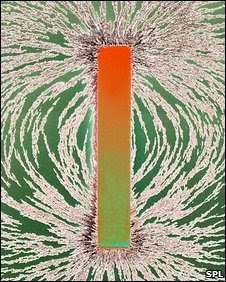
The loops of a magnetic field can be seen in the arrangement of iron filings
Now one of those teams has gone on to show that these "quasi-particles" of magnetic charge can move together, forming a magnetic current just like the electric current formed by moving electrons.

They did so by using sub-atomic particles called muons, created at the Science and Technology Facilities Council's (STFC) ISIS neutron and muon source near Oxford.

The muons decay millionths of a second after their production into other sub-atomic particles. But the direction in which these resulting particles fly off is an indicator of the magnetic field in a tiny region around the muons.
http://news.bbc.co.uk/2/hi/technology/8307804.stm

Thursday, September 24, 2009

The Magnetic Field One of Nature's Great Mystries

If there is a current flowing in a wire then there will exist a magnetic field around it. Looks like the magnetic field and current are companions! What is this mystery?

Monday, September 21, 2009

The Speed of Light What is The Definition?

As it stands now the speed of light is defined in terms of miles per second, or measurement of length over measurement of time.
The problem there is no definition of length and time in the abstract sense.