Thursday, April 27, 2017

superior intelligence beyond humans by Sherif S Monem

Is there a superior intelligence that are beyond humans to understand. Just curious.

Monday, June 6, 2016

APS JOURNALS

January 2016

Tips for Authors

General

When you first log into the new submission server you will notice that there are headings listed with the different phases of processing your manuscript goes through at the editorial office. (You may or may not see all of these, depending on what stage your manuscript is at.) So what do they mean?

Update your Contact Information

On the upper left side of the page you will notice your name, email address, and affiliation. Simply click on the Update button to change any of this information if necessary.

Create a new submission

Click on this button and you can start the submission of a new manuscript. (As well as update your contact information if needed.)

Unfinished/Not yet (re)submitted

You have started a new submission and chosen to save it for later or did not hit the submit button when you were finished.

With Submissions Staff

A completed (re)submission will appear here until APS submissions staff process it.

With Authors

You have been sent a message regarding your manuscript from the editors; no further action will be taken on the manuscript until we hear back from you.

With Editor(s)

When your (re)submission is processed it will appear under this heading until it is sent out for review or the editor contacts you with other information.

Under Review

Your manuscript is currently out for review.

Accepted/Published

When your paper has been accepted or published it will appear under this heading with a link to the accepted or published paper.

How Can I:

  • See PDF sent to Referee(s)– Go to the Under Review heading and click on the APS manuscript code (highlighted in red). It will bring you to an information page for that manuscript where you can click on the “Download Manuscript PDF” option. This is the current PDF sent to the referee(s).
  • Check Status - At any time you can click on the “Status” link, to the far right of where the APS manuscript code number appears, to find the status of your manuscript as it is being processed. From there you can also see the details of your (re)submission or contact the editors regarding the (re)submission as well if you should have any concerns.

Preparation for Submission: Editorial Guidelines

Color Figures

Consider whether you wish color figures in print or whether color online only and grayscale in print will be adequate. Be aware that color figures in print incur substantial charges for which authors and their institutions are responsible. Please see the Color-in-Print memo for our pricing and payment policy. If the article is accepted, these charges must be paid before it can be forwarded to our composition vendor for publication. Electronic figures submitted in color (PostScript or EPS preferred) will be published online in color at no extra charge to authors. Note, however, that grayscale images printed from color figures do not generally have monotonic gray scales.
For color online figures only, take care to ensure that captions and text references to the figures are appropriate for both the online color and print grayscale versions, and that the figure will be sufficiently clear in both versions. (The same figure file is used for both the print and the online versions.)

References

Check the accuracy of your references. (Avoid broken links in the online version of the journal.)
Include the complete source information for any references cited in the abstract. (Do not cite reference numbers in the abstract. Abstracts are reprinted in various abstract journals and databases where the numerical citation is not useful.)
Number references in text consecutively, starting with [1].

Language

If your native language is not English, please consider enlisting the help of an English-speaking colleague in preparing the text.
Use a spell checker. (Referees are not favorably impressed by careless mistakes.)

Submission

Submit electronic files that are acceptable for a publication charge discount (PRL) or waiver (Phys. Rev.) in your original submission. Do not wait until your manuscript is accepted. Acceptable formats for the discount or waiver include REVTeX (preferred), LaTeX, and MSWord. Portable Document Format (PDF) or PostScript files are not eligible for the charge discount or waiver and could result in unnecessary delay.
Figures should be submitted separately. We prefer PostScript or EPS files.
For more information, see the Web Submission Guidelines.

Referees

With your submission, include a list of possible referees who are experts on the subject matter and not your close colleagues. Please consider including younger individuals who, while possibly less well known, are sufficiently knowledgeable to be effective referees.

Preparation for Submission: Technical Guidelines

Please use standard Windows fonts in any Word document. If you use an unusual font, we will probably not have it and, therefore, be unable to convert your Word document to PDF for viewing.
We recommend conventional file naming (plain ascii without punctuation or spaces) and a flat directory structure; non-conforming file names and subdirectories will prevent successful preview PDF generation.
If submitting from a large collaboration, please follow the Guidelines for Collaboration Submissions to ensure proper coding of the author list in your REVTeX file.
Include figures in your Word document as pictures. Include equations by using Design Science's MathType equation editor rather than Word's built-in editor, and tables by using Word's Table Editor. Please do not embed any of these items as objects, since this will cause a problem with our conversion of your file to PDF.
Submit separate figure files (PostScript or EPS preferred) in addition to embedding the figures in the manuscript if you submit in MS Word or PDF format. Although we discourage the use of any unusual fonts, if it is necessary, please embed these type fonts in your PostScript or EPS files so that we are able to generate proper output.
For REVTeX and LaTeX files, please run BibTeX before submitting your paper, and read-in (i.e., \input) or paste the resulting .bbl file within the reference section of your paper.
If your attempted submission is not successful, please do not begin a new submission. Please continue with the same attempted submission, or send a message to help@aps.org for further assistance. Do not start numerous, unnecessary submissions.
When sending a message for assistance to help@aps.org, please be sure to include the full text of any error messages received. This will help us to determine quickly and resolve the source of any problems encountered.

After Submission

In any resubmission letter, provide (1) a concise summary of your rebuttal to the major points of criticism raised by the referees, (2) a point by point, polite, professional response to the referee reports, and (3) a list of changes.

If your paper is accepted, please check the proofs carefully, even if you have submitted your paper as an electronic file. (The conversion, copy-editing, and formatting processes will inevitably introduce changes and some errors might result.)

Saturday, March 5, 2016

The Solar Planets

 Artist's impression of the planets in our solar system, along with the Sun (at bottom). Credit: NASA

Mercury: Overview: The Swiftest Planet

Mercury's surface temperatures range from 467 degrees Celsius (872 degrees Fahrenheit) to -183 degrees Celsius (-300 degrees Fahrenheit).
Mars’ average surface temperature is -55 °C, but the Red Planet also experiences some variability, with temperatures ranging as high as 20 °C at the equator during midday, to as low as -153 °C at the poles. On average though, it is much colder than Earth, being just on the outer edge of the habitable zone, and because of its thin atmosphere – which is not sufficient to retain heat.
In addition, its surface temperature can vary by as much as 20 °C due to Mars’ eccentric orbit around the Sun (meaning that it is closer to the Sun at certain points in its orbit than at others).

What is the Average Surface Temperature of the Planets in our Solar System?

15 Dec , 2014 by
It’s is no secret that Earth is the only inhabited planet in our Solar System. All the planets besides Earth lack a breathable atmosphere for terrestrial beings, but also, many of them are too hot or too cold to sustain life. A “habitable zone” which exists within every system of planets orbiting a star. Those planets that are too close to their sun are molten and toxic, while those that are too far outside it are icy and frozen.
But at the same time, forces other than position relative to our Sun can affect surface temperatures. For example, some planets are tidally locked, which means that they have one of their sides constantly facing towards the Sun. Others are warmed by internal geological forces and achieve some warmth that does not depend on exposure to the Sun’s rays. So just how hot and cold are the worlds in our Solar System? What exactly are the surface temperatures on these rocky worlds and gas giants that make them inhospitable to life as we know

Of our eight planets, Mercury is closest to the Sun. As such, one would expect it to experience the hottest temperatures in our Solar System. However, since Mercury also has no atmosphere and it also spins very slowly compared to the other planets, the surface temperature varies quite widely.
What this means is that the side exposed to the Sun remains exposed for some time, allowing surface temperatures to reach up to a molten 465 °C. Meanwhile, on the dark side, temperatures can drop off to a frigid -184°C. Hence, Mercury varies between extreme heat and extreme cold and is not the hottest planet in our Solar System.

Venus: Overview: Planetary Hot Spot

That honor goes to Venus, the second closest planet to the Sun which also has the highest average surface temperatures – reaching up to 460 °C on a regular basis. This is due in part to Venus’ proximity to the Sun, being just on the inner edge of the habitability zone, but also to Venus’ thick atmosphere, which is composed of heavy clouds of carbon dioxide and sulfur dioxide.
These gases create a strong greenhouse effect which traps a significant portion of the Sun’s heat in the atmosphere and turns the planet surface into a barren, molten landscape. The surface is also marked by extensive volcanoes and lava flows, and rained on by clouds of sulfuric acid. Not a hospitable place by any measure!

Our Home Planet

Mars: Overview: The Red Planet

Minimum/Maximum Surface Temperature
-88/58 (min/max) °C
-153 to +20 °C
Atmospheric Constituents
Nitrogen, Oxygen
Carbon Dioxide, Nitrogen, Argon

Jupiter: Overview: King of the Planets

Since Jupiter is a gas giant, it has no solid surface, so it has no surface temperature. But measurements taken from the top of Jupiter’s clouds indicate a temperature of approximately -145°C. Closer to the center, the planet’s temperature increases due to atmospheric pressure.
At the point where atmospheric pressure is ten times what it is on Earth, the temperature reaches 21°C, what we Earthlings consider a comfortable “room temperature”. At the core of the planet, the temperature is much higher, reaching as much as 35,700°C – hotter than even the surface of the Sun.

Saturn: Overview: Jewel of Our Solar System

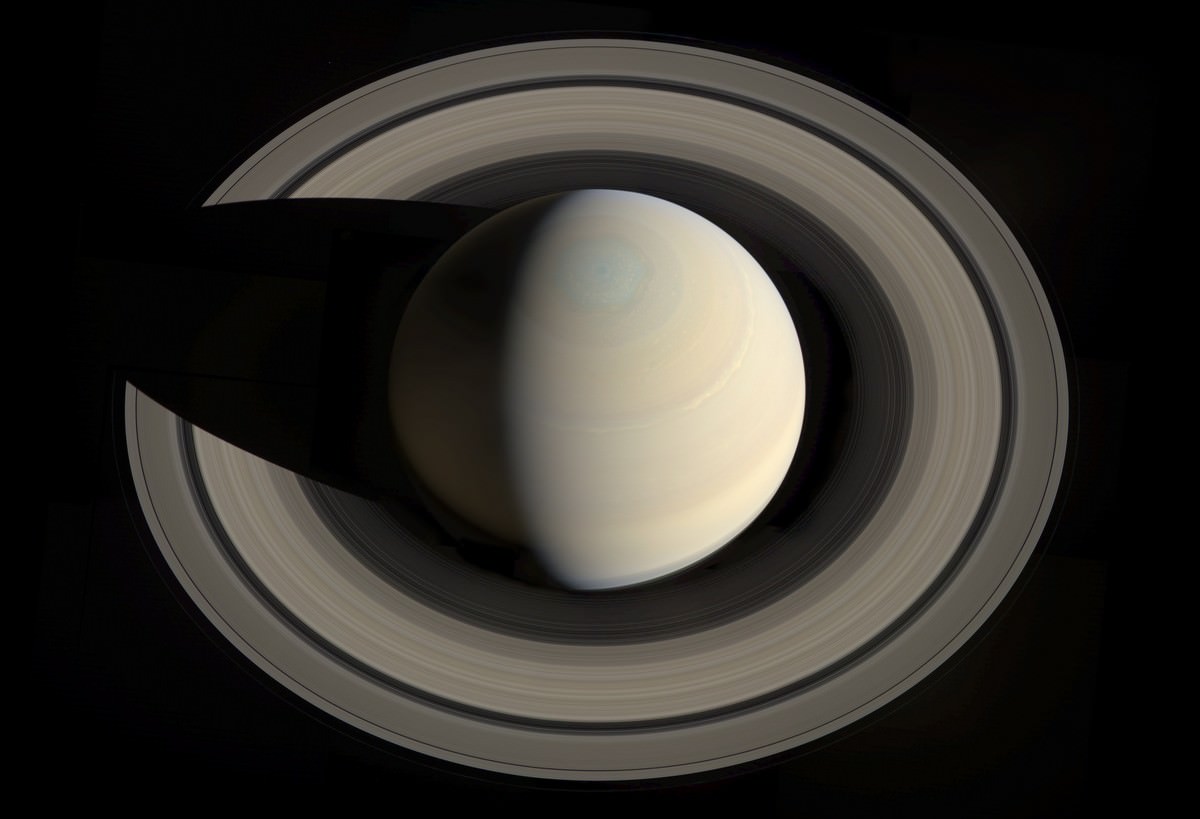
Due to its distance from the Sun, Saturn is a rather cold gas giant planet, with an average temperature of -178 °Celsius. But because of Saturn’s tilt, the southern and northern hemispheres are heated differently, causing seasonal temperature variation.

Uranus: Overview: The Sideways Planet

Neptune: Overview: The Windiest Planet

..

..

The Sun

The Sun: In Depth:


The sun is the closest star to Earth, at a mean distance from our planet of 149.60 million kilometers (92.96 million miles). This distance is known as an astronomical unit (abbreviated AU), and sets the scale for measuring distances all across the solar system. The sun, a huge sphere of mostly ionized gas, supports life on Earth. The connection and interactions between the sun and Earth drive the seasons, ocean currents, weather and climate. It is the center of our solar system.
About one million Earths could fit inside the sun. It is held together by gravitational attraction, producing immense pressure and temperature at its core. The sun has six regions - the core, the radiative zone, and the convective zone in the interior; the visible surface (the photosphere); the chromosphere; and the outermost region, the corona. The sun has no solid surface.
At the core, the temperature is about 15 million degrees Celsius (about 27 million degrees Fahrenheit), which is sufficient to sustain thermonuclear fusion. The energy produced in the core powers the sun and produces essentially all the heat and light we receive on Earth. Energy from the core is carried outward by radiation, which bounces around the radiative zone, taking about 170,000 years to get from the core to the convective zone. The temperature drops below 2 million degrees Celsius (3.5 million degrees Fahrenheit) in the convective zone, where large bubbles of hot plasma (a soup of ionized atoms) move upwards.
The sun's surface - the photosphere - is a 500-kilometer-thick (300-mile-thick) region, from which most of the sun's radiation escapes outward and is detected as the sunlight we observe here on Earth about eight minutes after it leaves the Sun. Sunspots in the photosphere are areas with strong magnetic fields that are cooler, and thus darker, than the surrounding region. Sunspot numbers fluctuate every 11 years as part of the sun's magnetic activity cycle. Also connected to this cycle are bright solar flares and huge coronal mass ejections that blast off the sun.
The temperature of the photosphere is about 5,500 degrees Celsius (10,000 degrees Fahrenheit). Above the photosphere lie the tenuous chromosphere and the corona (crown). Visible light from these top regions is usually too weak to be seen against the brighter photosphere, but during total solar eclipses, when the Moon covers the photosphere, the chromosphere can be seen as a red rim around the sun while the corona forms a beautiful white crown with plasma streaming outward, forming the points of the crown.
Above the photosphere, temperature increases with altitude, reaching as high as 2 million degrees Celsius (3.5 million degrees Fahrenheit). The source of coronal heating has been a scientific mystery for more than 50 years. Likely solutions emerged from observations by the Solar and Heliospheric Observatory (SOHO) and the Transition Region and Coronal Explorer (TRACE) missions, but the complete answer still evades scientists. Recent missions - Hinode, Solar Terrestrial Relations Observatory (STEREO), and the Solar Dynamics Observatory (SDO) - greatly improved our knowledge of the corona, getting us still closer to the answer. They also give us an unprecedented understanding of the physics of space weather phenomena such as solar flares, coronal mass ejections, and solar energetic particles. Space weather can adversely affect our technology in space and on Earth; these missions help us to develop space weather reports.

History
The sun has inspired mythological stories in cultures around the world, including those of the ancient Egyptians, the Aztecs of Mexico, Native American tribes of North America and Canada, the Chinese and many others.
A number of ancient cultures built stone structures or modified natural rock formations to mark the motions of the sun and moon - they charted the seasons, created calendars and monitored solar and lunar eclipses. These architectural sites show evidence of deliberate alignments to astronomical phenomena: sunrises, moonrises, moonsets, even stars or planets. Many cultures believed that the Earth was immovable and the sun, other planets, and stars revolved about it. Ancient Greek astronomers and philosophers knew this geocentric concept from as early as the 6th century BCE. Now we know, of course, that all the planets orbit our lone star - the sun.

How the Sun Got its Name
The sun has many names in many cultures, all of them presumably pre-historic in their origins. The ancient Greeks called it Helios and the ancient Romans called it Sol, both of which derive from the same Proto-Indo-European term. Latin Sol developed as sole in Italian, sol in Portuguese and Spanish, and with the addition of an originally diminutive suffix, as soleil in French. Modern English sun evolved from the same Proto-Germanic form that today is Sonne in German and zon in Dutch, variously attested as sonne and sunne in Old and Middle English, with similar forms found in other ancient Germanic languages such as Old Norse, Old Saxon, Old High German and Gothic.

..

Saturday, January 11, 2014

Black-body radiation quantization

Radiation quantization

Black-body radiation, the emission of electromagnetic energy due to an object's heat, could not be explained from classical arguments alone. The equipartition theorem of classical mechanics, the basis of all classical thermodynamic theories, stated that an object's energy is partitioned equally among the object's vibrational modes. This worked well when describing thermal objects, whose vibrational modes were defined as the speeds of their constituent atoms, and the speed distribution derived from egalitarian partitioning of these vibrational modes closely matched experimental results. Speeds much higher than the average speed were suppressed by the fact that kinetic energy is quadratic—doubling the speed requires four times the energy—thus the number of atoms occupying high energy modes (high speeds) quickly drops off because the constant, equal partition can excite successively fewer atoms. Low speed modes would ostensibly dominate the distribution, since low speed modes would require ever less energy, and prima facie a zero-speed mode would require zero energy and its energy partition would contain an infinite number of atoms. But this would only occur in the absence of atomic interaction; when collisions are allowed, the low speed modes are immediately suppressed by jostling from the higher energy atoms, exciting them to higher energy modes. An equilibrium is swiftly reached where most atoms occupy a speed proportional to the temperature of the object (thus defining temperature as the average kinetic energy of the object).
But applying the same reasoning to the electromagnetic emission of such a thermal object was not so successful. It had been long known that thermal objects emit light. Hot metal glows red, and upon further heating, white (this is the underlying principle of the incandescent bulb). Since light was known to be waves of electromagnetism, physicists hoped to describe this emission via classical laws. This became known as the black body problem. Since the equipartition theorem worked so well in describing the vibrational modes of the thermal object itself, it was trivial to assume that it would perform equally well in describing the radiative emission of such objects. But a problem quickly arose when determining the vibrational modes of light. To simplify the problem (by limiting the vibrational modes) a longest allowable wavelength was defined by placing the thermal object in a cavity. Any electromagnetic mode at equilibrium (i.e. any standing wave) could only exist if it used the walls of the cavities as nodes. Thus there were no waves/modes with a wavelength larger than twice the length (L) of the cavity.
Standing waves in a cavity
The first few allowable modes would therefore have wavelengths of : 2L, L, 2L/3, L/2, etc. (each successive wavelength adding one node to the wave). However, while the wavelength could never exceed 2L, there was no such limit on decreasing the wavelength, and adding nodes to reduce the wavelength could proceed ad infinitum. Suddenly it became apparent that the short wavelength modes completely dominated the distribution, since ever shorter wavelength modes could be crammed into the cavity. If each mode received an equal partition of energy, the short wavelength modes would consume all the energy. This became clear when plotting the Rayleigh–Jeans law which, while correctly predicting the intensity of long wavelength emissions, predicted infinite total energy as the intensity diverges to infinity for short wavelengths. This became known as the ultraviolet catastrophe.
The solution arrived in 1900 when Max Planck hypothesized that the frequency of light emitted by the black body depended on the frequency of the oscillator that emitted it, and the energy of these oscillators increased linearly with frequency (according to his constant h, where E = hν). This was not an unsound proposal considering that macroscopic oscillators operate similarly: when studying five simple harmonic oscillators of equal amplitude but different frequency, the oscillator with the highest frequency possesses the highest energy (though this relationship is not linear like Planck's). By demanding that high-frequency light must be emitted by an oscillator of equal frequency, and further requiring that this oscillator occupy higher energy than one of a lesser frequency, Planck avoided any catastrophe; giving an equal partition to high-frequency oscillators produced successively fewer oscillators and less emitted light. And as in the Maxwell–Boltzmann distribution, the low-frequency, low-energy oscillators were suppressed by the onslaught of thermal jiggling from higher energy oscillators, which necessarily increased their energy and frequency.
The most revolutionary aspect of Planck's treatment of the black body is that it inherently relies on an integer number of oscillators in thermal equilibrium with the electromagnetic field. These oscillators give their entire energy to the electromagnetic field, creating a quantum of light, as often as they are excited by the electromagnetic field, absorbing a quantum of light and beginning to oscillate at the corresponding frequency. Planck had intentionally created an atomic theory of the black body, but had unintentionally generated an atomic theory of light, where the black body never generates quanta of light at a given frequency with an energy less than . However, once realizing that he had quantized the electromagnetic field, he denounced particles of light as a limitation of his approximation, not a property of reality.

Photoelectric effect illuminated[edit]

Yet while Planck had solved the ultraviolet catastrophe by using atoms and a quantized electromagnetic field, most physicists immediately agreed that Planck's "light quanta" were unavoidable flaws in his model. A more complete derivation of black body radiation would produce a fully continuous, fully wave-like electromagnetic field with no quantization. However, in 1905 Albert Einstein took Planck's black body model in itself and saw a wonderful solution to another outstanding problem of the day: the photoelectric effect. Ever since the discovery of electrons eight years previously, electrons had been the thing to study in physics laboratories worldwide.
In 1902 Philipp Lenard discovered that (within the range of the experimental parameters he was using) the energy of these ejected electrons did not depend on the intensity of the incoming light, but on its frequency. So if one shines a little low-frequency light upon a metal, a few low energy electrons are ejected. If one now shines a very intense beam of low-frequency light upon the same metal, a whole slew of electrons are ejected; however they possess the same low energy, there are merely more of them. In order to get high energy electrons, one must illuminate the metal with high-frequency light. The more light there is, the more electrons are ejected. Like blackbody radiation, this was at odds with a theory invoking continuous transfer of energy between radiation and matter. However, it can still be explained using a fully classical description of light, as long as matter is quantum mechanical in nature.[6]
If one used Planck's energy quanta, and demanded that electromagnetic radiation at a given frequency could only transfer energy to matter in integer multiples of an energy quantum , then the photoelectric effect could be explained very simply. Low-frequency light only ejects low-energy electrons because each electron is excited by the absorption of a single photon. Increasing the intensity of the low-frequency light (increasing the number of photons) only increases the number of excited electrons, not their energy, because the energy of each photon remains low. Only by increasing the frequency of the light, and thus increasing the energy of the photons, can one eject electrons with higher energy. Thus, using Planck's constant h to determine the energy of the photons based upon their frequency, the energy of ejected electrons should also increase linearly with frequency; the gradient of the line being Planck's constant. These results were not confirmed until 1915, when Robert Andrews Millikan, who had previously determined the charge of the electron, produced experimental results in perfect accord with Einstein's predictions. While the energy of ejected electrons reflected Planck's constant, the existence of photons was not explicitly proven until the discovery of the photon antibunching effect, of which a modern experiment can be performed in undergraduate-level labs.[7] This phenomenon could only be explained via photons, and not through any semi-classical theory (which could alternatively explain the photoelectric effect). When Einstein received his Nobel Prize in 1921, it was not for his more difficult and mathematically laborious special and general relativity, but for the simple, yet totally revolutionary, suggestion of quantized light. Einstein's "light quanta" would not be called photons until 1925, but even in 1905 they represented the quintessential example of wave–particle duality. Electromagnetic radiation propagates following linear wave equations, but can only be emitted or absorbed as discrete elements, thus acting as a wave and a particle simultaneously.

http://en.wikipedia.org/wiki/Wave%E2%80%93particle_duality